“Behind every powerful woman is more powerful women” serves as the heartbeat of SUFFS, which arrived at Playhouse Square during the first week of February. SUFFS is a contemporary Broadway musical that brings the American women’s suffrage movement to life by centering the collective effort behind the fight for the 19th Amendment. Created by Shaina Taub, the show follows leaders like Alice Paul, Lucy Burns, and Ida B. Wells as they organize, argue, and mobilize in pursuit of the vote.
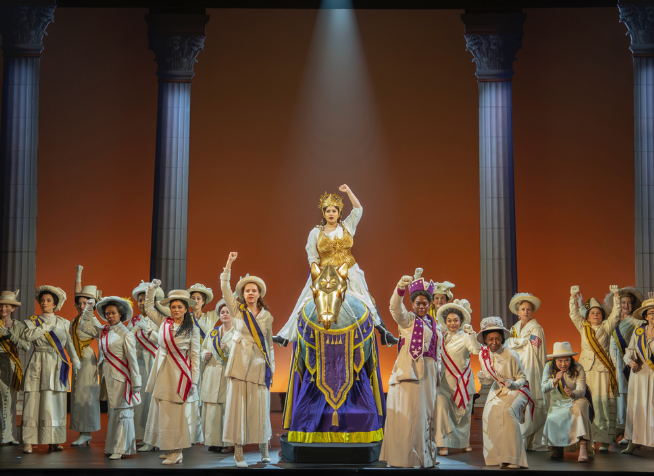
Rather than presenting suffrage as a unified or orderly campaign, SUFFS highlights the coalitions, conflicts, and grassroots' work that fueled progress. Those themes resonate deeply in Cleveland, where women’s clubs, reform groups, and civic leaders played an active role in advancing suffrage, making the musical’s arrival at Playhouse Square a meaningful reflection of the city’s own history.
Cleveland’s connection to suffrage predates the movement itself. Before the Civil War, Cleveland was a major center of the abolitionist movement. Many abolitionists viewed women’s suffrage as essential to achieving full equality and citizenship, helping link the causes of abolition and women’s rights in the city. National women’s rights conventions soon reached Northeast Ohio. The 1851 convention in Akron became especially significant as the site of Sojourner Truth’s “Ain’t I a Woman” speech, cementing the region’s importance in the national movement. While suffrage organizing brought many women together, women of color often faced exclusion within reform spaces even as they fought for rights that affected them directly.
In the years leading up to the Civil War, women in Cleveland continued their efforts locally, though national momentum slowed during the war. Afterward, activism surged again. Leaders such as Harriet Taylor Upton Severance, a philanthropist and reformer, helped position Cleveland as a hub for post–Civil War suffrage organizing. Local clubwomen and activists built strong coalitions through churches, reform societies, and women’s rights organizations. Cleveland women played key roles in founding and sustaining the Ohio Woman’s Suffrage Association, hosting conventions, lobbying lawmakers, and keeping the issue of the vote alive in public discourse. Their work reflected a broader truth of the movement: progress was not achieved by a single figure, but by groups of committed women working collectively to push Cleveland, Ohio, and the nation closer to equality.
In 1916, women in East Cleveland gained the right to vote in municipal elections. In 1917, women in Lakewood and Columbus followed. That same year, the Reynolds Bill, which would have allowed women to vote in the upcoming presidential election, was passed. However, it was quickly repealed by voter referendum, echoing a central truth SUFFS captures: progress rarely moves in a straight line. On June 16, 1919, Ohio became the fifth state to ratify the 19th Amendment, helping secure voting rights for women nationwide and marking the culmination of decades of organizing rooted in cities like Cleveland.
SUFFS transforms the history of women’s suffrage into something immediate and deeply human by telling the story through contemporary music. Rather than presenting suffrage as a distant series of dates and legislation, the musical captures the emotion, urgency, and persistence behind the fight for the vote. Through song, audiences experience the hope, frustration, and determination that defined the movement, making history feel alive and accessible.
More than a story about a single amendment, SUFFS explores how lasting change happens. The musical centers on collective action: coalitions, disagreements, strategy shifts, and perseverance. It shows that progress is rarely neat or inevitable. By focusing on the work of many rather than the triumph of one, SUFFS reflects the real dynamics of social movements and the long road toward meaningful reform.
Although rooted in the early 20th century, SUFFS feels unmistakably current. Its themes raise enduring questions about civic participation, representation, and responsibility, which are questions that continue to shape American democracy today. Importantly, the show frames voting not as a partisan issue, but as a peaceful, constitutional means through which citizens express their voices and shape their communities. Experiencing SUFFS in Cleveland adds special resonance, given the city’s history of abolitionism, reform, and women‑led organizing.